
Product · talent development platform
His goals, his sprint time, his touches, his hours on the pitch, all tracked since he was ten. The one thing that decides whether he makes it has never been measured and never been coached. Now it is.
His ranking, his serve speed, his match record, his hours on court, all tracked since he was ten. The one thing that decides whether he makes it has never been measured and never been coached. Now it is.
1The player· He improves faster
You find out a player is slipping in the week it happens, not when it finally shows in results. And it costs your coaches nothing: he writes it himself, and it reaches them before the next session.
A few minutes in his own words after a session. His coach reads it before the next one, so nobody starts from scratch.
One technique a week on his weakest area. Not be more confident. Something he can actually practice.
One cue he picked himself to take onto court.One cue he picked himself to take onto the pitch. That is where six weeks of training either shows up or does not.
2The coach· Nobody gets missed
Three sessions a week on a court is all you get.Three sessions a week on the pitch is all you get. The record is the rest of it, including the places where what you see and what he says about himself do not match.
Effort, focus and body language, never reworded. The moment the words change, nothing compares to anything.
You rate his body language a four. He rates himself a two. He will never say that out loud, and it is the thing worth coaching.
Three values per player, spoken rather than typed. Anything heavier and you would have stopped by November.
3The director· Caught in the week it happens
Every player who needs attention arrives with the reason attached, sorted by how much it matters. These are things that already happened, not forecasts of things that might.
You open it and the players who need you are already at the top.
Quiet for ten days. Readiness down three weeks running. A hard week of results.
By the time a bad month reaches the scoreboard, the term is already gone.
We never predict who will make it, and nothing is rewritten after the fact.
One reason per player, worst first.
Fourteen players. These five are the ones the week asks about.
4The parent· From pressure to support
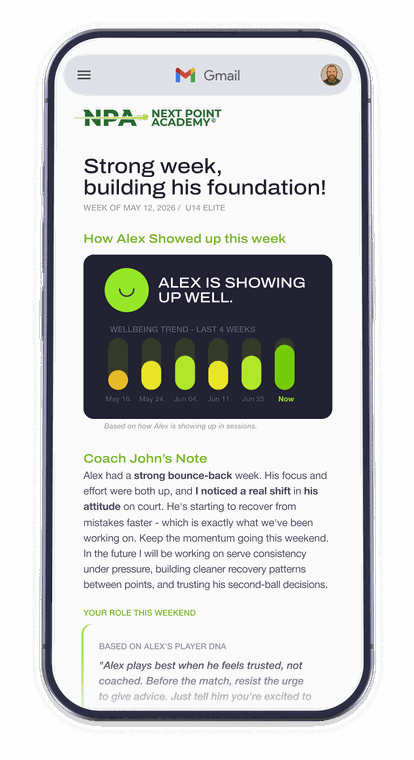
You were courtside. You saw the third set. What you did not see is what his coaches have watched all month, and what he says about it himself. Parents get a trend, a note in plain language, and one thing to talk about that is not the result.
It arrives under the academy's brand, from you.
He already has a rating. This is the part it does not measure.
So the drive home has a subject that is not the result.
Illustrative content in the real template.
4The parent· From pressure to support
You have that conversation anyway, usually defending a decision with nothing in your hand. This is what you walk in holding: what his coaches have seen all season, where his body sits against his age, and the one thing he is working on. Shown the same picture you are, a parent has something to do on Saturday instead of something to argue about.
The opening line is written for the coach, out of the boy's own record.
Nineteen months behind his age group is a maturity gap that closes on its own. Say it before anyone decides he is being overlooked.
The technique, and how often he reached for it. It gives a parent something to back at home rather than something to question.
Illustrative content in the real template.
PARENT · IN THE INBOXFrom your academy · Leo's week
Trend
From Coach Daniel
"He went straight to the next point after the double fault. That reset is getting quicker."
One thing to talk about
Ask him what he says to himself before he serves.
5The scout· Years, not two matchesYears, not a number
A club decides on ninety minutes and a highlight reel.A university coach decides on a UTR and a recruiting video. The rating says how he plays. It says nothing about whether he is still getting better. You hand them five seasons: the same three ratings from every coach who worked with him, and what he did with what he was told.
Hundreds of observations on the same scale, so one coach having a bad term cannot carry the picture.
Every correction a coach made, and whether he was still doing it a season later.
Months behind his age group closes on its own. Off the record, a club reads it as his ceiling.Off the record, a recruiter reads it as his ceiling.
Illustrative record.
412 observations
5 seasons, 7 coaches
What his coaches asked him to work on
No ranking. No prediction. Not rewritable. Shared with the family's consent.
Your data
Every rating, note and season belongs to your academy, and it keeps growing in value the longer you use it. Ask for the full record and we send it to you. If you ever move on, we delete our copy within 30 days. We want you to stay because it works, not because your data is locked in.
6Your brand· Your academy, not ours
The app opens under your name, your crest and your colors, and every parent email arrives the same way. Nothing a family touches is branded Future Stars.
Your logo and your welcome line, set once and live for every player in the academy.
Parents read your academy's name in the inbox every week, not a vendor they have never heard of.
We handle the setup. You send the logo and the squad, and the academy is running that week.
Illustrative academy. Your own crest and colors are set during onboarding.
YOUR BRAND · FIRST SCREEN
YOUR BRAND · FIRST SCREENEverything
No feature tiers and no add-ons. Scouts and buying clubs never log in: what reaches them is the Development Record, handed over by the academy.
Thirty minutes, nothing to prepare. Bring one age group and we will show you what the first month would surface.