


Nexon Dunakeszi Tennis Club just went live on Future Stars.
Dunakeszi is widely regarded as Hungary’s most successful junior tennis development program: hundreds of national individual and team championship titles. Head coach Tamás Bogyó captains Hungary’s Championship Bowl team, winner of the international final in both 2025 and 2026. It’s one of the few academies in the country built around a genuinely international competitive mindset, with players on the Tennis Europe and ITF junior circuits who’ve won multiple international titles, and a campus that hosts international access weeks and full-time students.
Results like that don’t lower the pressure. They raise it. The gap in junior development isn’t on-court hours. It’s the 23 hours between sessions, and at a program where parents expect international results, that gap gets watched closely.
Tamás Bogyó has also coached 3 ATP/WTA Top 100 players, 6 ITF Junior Top 100 players, and seen 13 of his juniors earn U.S. college scholarships. His parents gave Dunakeszi an NPS of 92. They don’t just like the club. They advocate for it.
Future Stars surveyed them anyway.
85% want more feedback on how their child is doing in sessions. 69% want to know how their child actually feels. In their own words:
“What goes through his mind after mistakes? I don’t know how to help.”
“I want to understand what’s happening inside my child’s head between sessions.”
“I wish I knew what he was feeling after a loss.”
Not one question about technique.
The questions don’t stop. They just move to Sunday night.
Tamás knows the answers. That’s the problem. He spends 5 to 10 hours a week giving them, one parent at a time. Sunday evenings. After tournaments. In the car park on the way to the next session.
Every one of those hours is an hour not on court. And it isn’t only a time problem. When a parent has to ask, the parent is setting the agenda. A bad loss at a Tennis Europe event becomes a phone call on Sunday, and the coach spends that call defending a plan instead of explaining it.
That’s what exceptional results do. Parents who send their kids to the country’s top program, who watch them compete internationally, expect to see the payoff. Not because they’re unreasonable. Because the only information they have by default is the scoreboard and whatever their child says on the drive home. Fill that vacuum with one bad result against an ITF-ranked opponent and you get pressure, even from parents who gave the club a 92.
The fix isn’t more conversations. It’s leading with the data.
Future Stars runs on one weekly loop with three jobs.
Players train pressure skills: twelve weeks, twelve pro stories, twelve skills, with a short reflection each week that speaks to their own pressure type.
Coaches complete a weekly check-in per player. Effort, focus, mindset. A few taps each, done between sessions.

Parents get an automated report every week, written in the club’s voice, built from what the coach observed and what the player said. Nobody types forty updates by hand. The data already exists. It just gets turned into something a parent can read.
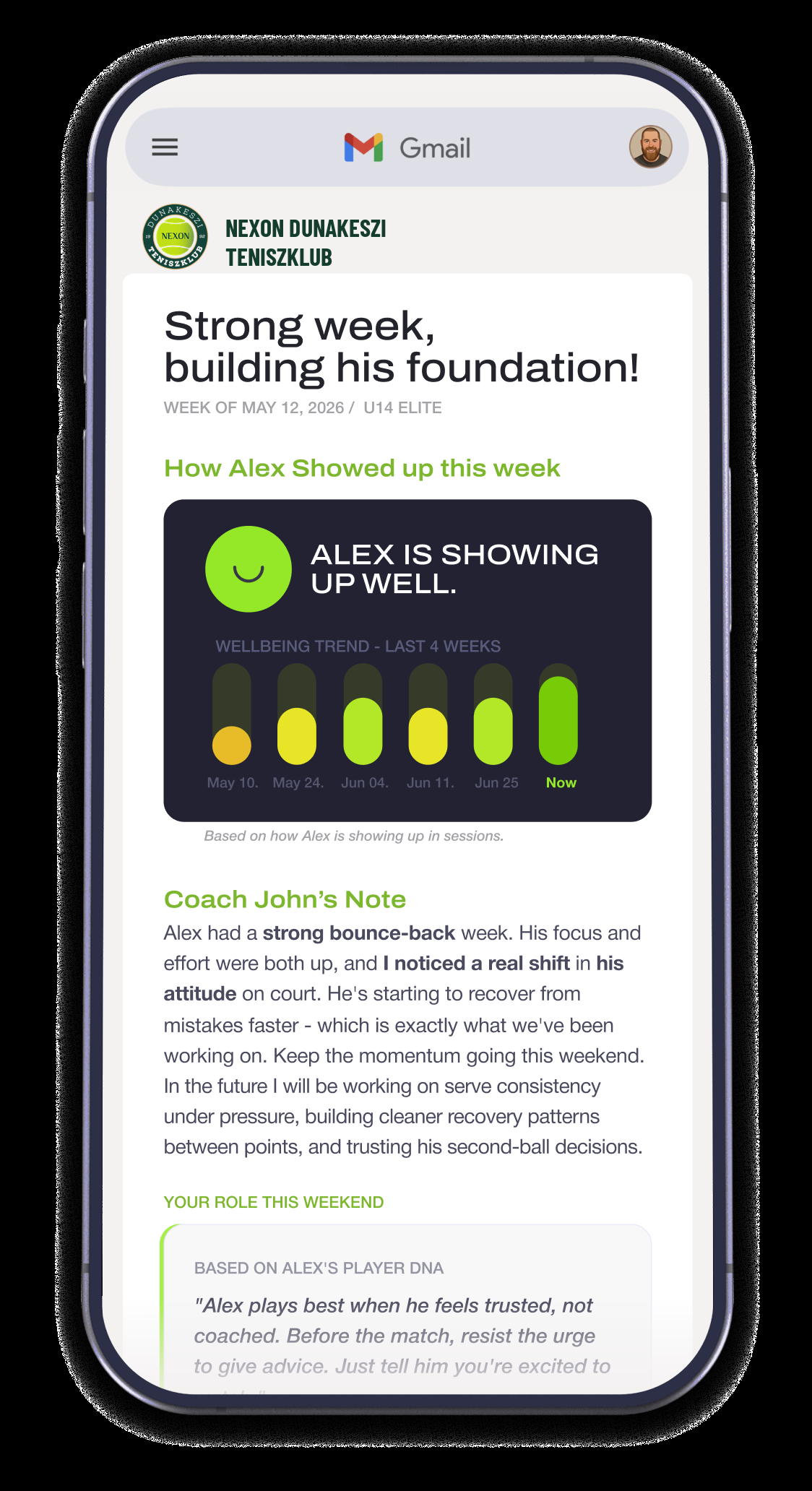
The order matters. The report lands before the parent thinks to ask. Development progress goes out first, and the conversation follows it, not the other way round.
What changes for the parent conversation
A parent who only sees results reacts to the last result. A parent who gets a report every week sees an arc.
A dip after a tough loss reads very differently against four weeks of steady climb in focus and bounce-back than it does on its own. The question stops being “why did he lose?” and becomes “the report says his focus held up even when the scoreline didn’t, what are you working on next?” That’s a conversation Tamás wants to have. The coach is leading it, with evidence, instead of answering for it.
And for the questions parents actually asked, what is going on inside my child’s head, there’s finally a real answer that doesn’t depend on catching the coach at the right moment.
“The parents here care, and that’s a good thing. But I was spending my Sunday evenings having the same conversation five different ways. Now they get the picture every week before they have to ask, and when we do talk, we’re talking about development, not just the result,” said Tamás Bogyó, Head Coach at Nexon Dunakeszi Tennis Club.
“Tamás built one of the best parent relationships we’ve seen in junior tennis, and it still cost him hours every week to maintain. That’s the tell. Even the best coaches end up as the information bottleneck. We didn’t change how Tamás coaches. We took the bottleneck away, so the data reaches parents first and the coach gets to lead,” said Andras Nemes, Founder and CEO of Future Stars.
Where this is headed
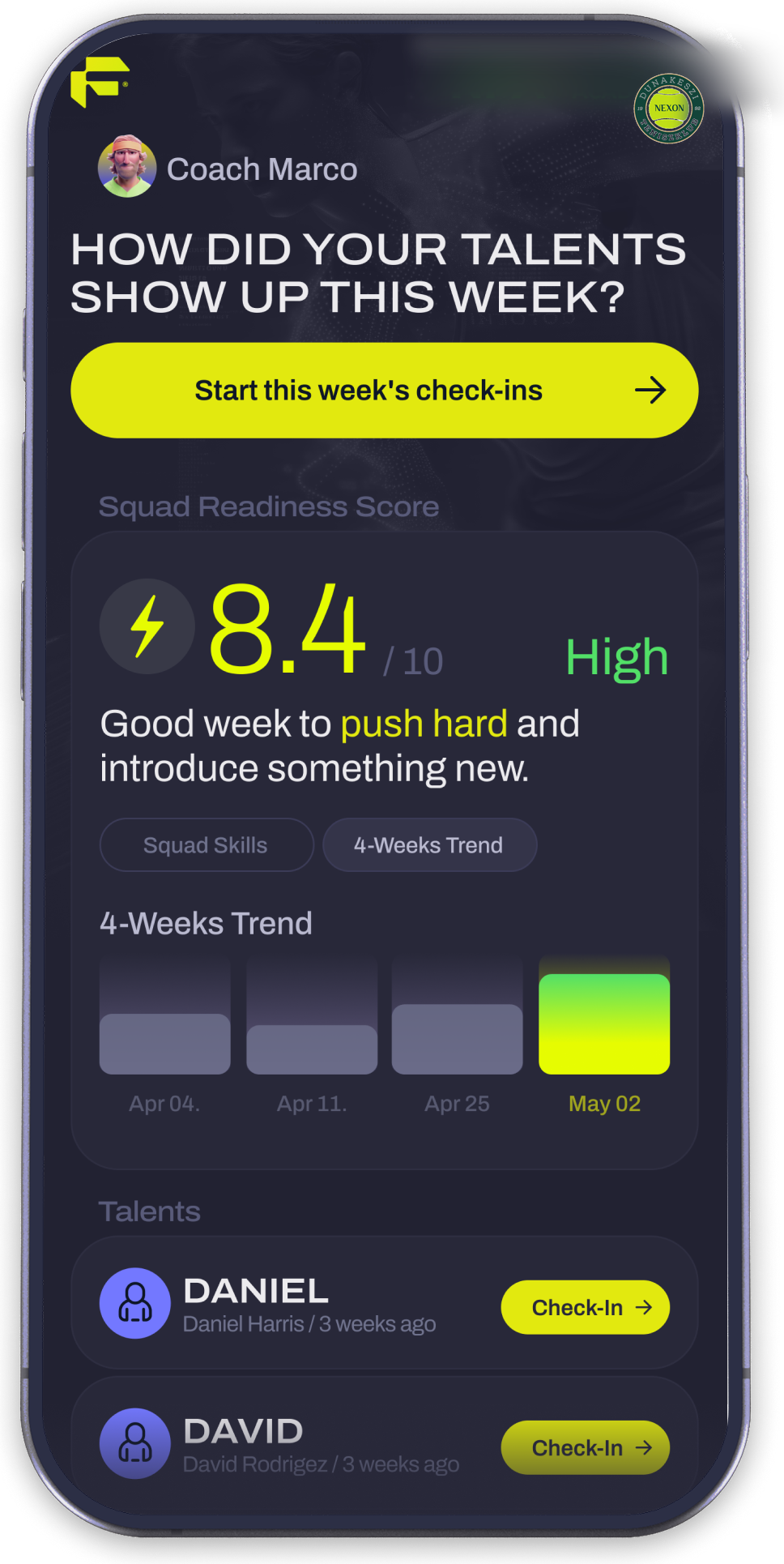
Right now, every report shows a Dunakeszi player against their own history: this week against last, this month against the start of the program. Over a season, that’s already the antidote to the one-bad-tournament panic.
Parents see a season, not a Saturday
One tournament, one bad result, and a parent used to draw conclusions from just that day. Now they’re watching a season build, and a dip after a tough loss reads differently against four weeks of steady climb than it does on its own.
A coach who knows the week before it starts
Squad readiness lands Monday morning. If effort is climbing but focus is slipping, that’s a different session plan than “they look tired,” and Tamás knows which one it is before the first ball.
A reference point beyond the club
The plan is anonymous benchmarking across every academy on Future Stars. For Dunakeszi, that means a real answer to how their juniors handle pressure compared to academies at a similar level, and a concrete number to sit next to the video in a scholarship packet. With 13 scholarships already earned, that’s not a hypothetical use case.
About Nexon Dunakeszi Tennis Club
Nexon Dunakeszi Tennis Club (Dunakeszi Teniszklub) is widely regarded as Hungary’s most successful junior tennis development program, with hundreds of national individual and team championship titles, located in Dunakeszi just north of Budapest. Head coach Tamás Bogyó captains Hungary’s Championship Bowl team, winner of the international final in both 2025 and 2026. Dunakeszi is one of the few academies in the country built around a genuinely international competitive mindset: players compete on the Tennis Europe and ITF junior circuits and have won multiple international titles, and the campus hosts international access weeks and full-time students. Its coaching has also produced 3 ATP/WTA Top 100 players, 6 ITF Junior Top 100 players, and 13 U.S. college scholarships, and its parents rate the club with an NPS of 92.
About Future Stars
How every player develops, recorded the same way, year after year.
Players complete weekly self-assessments on effort, focus, and inner talk, coaches get a squad-level view instead of relying on memory, and parents get an automated weekly report - all from the same weekly check-in. The platform is white-labeled under each academy’s own name and voice.